

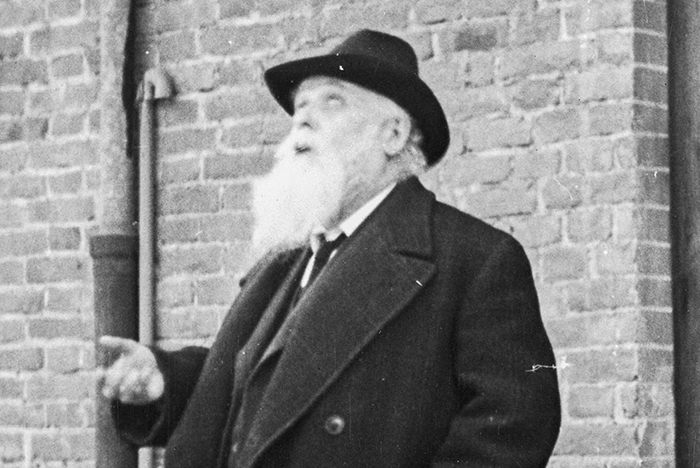
It was in one of these historic houses, at the entrance to the street, that Camillo Olivetti was born into a Jewish family on 16 August 1868. The writer Salvator Gotta left a memorable portrait of the Olivetti family, particularly Camillo’s mother and her fabric shop overlooking the street. In the opening pages of his novel Il progresso si diverte, he vividly recreates an atmosphere that would become so significant in the later history of Ivrea:
“Whenever the glass door of the fabric shop opened, a small bell would tinkle. But Mrs Olivetti was already there, behind a long counter that ran along two sides of the shop at right angles. She was a tiny woman of indeterminate age, with grey hair and a very small stature. Everyone in town knew, and therefore no one found it surprising, that Mrs Olivetti often smoked a Tuscan cigar in the afternoon. Her wrinkled face, almost always lit by a kindly smile, radiated a natural goodness and a gentleness perhaps born of an age-old sense of caution. Mrs Olivetti, her husband, his brother and their children were all renowned for their generosity, always ready to help anyone in need. They were wealthy, yet lived remarkably modest lives.”
Two further aspects of the street’s history deserve special mention. The first concerns its present name, which commemorates four young partisan fighters of the Garibaldi Divisions, all between eighteen and twenty years old, who were captured and executed by Nazi-Fascist forces in the Biella area during the Second World War. The “Four Martyrs” honoured by the street are Salvatore Solinas and Remo De Luca, both from Ivrea, Enrico Maucci from Forno Canavese, and Alfonso Guarneri from Enna.
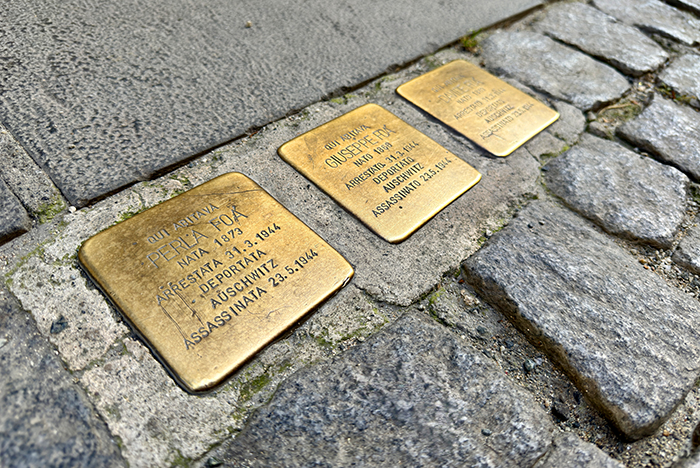
The second is the presence of three Stolpersteine (“stumbling stones”), installed along the street in 2018 in memory of Perla Faluomi Foa (who was also the Mugnaia of the Historic Carnival of Ivrea in 1892) and her brothers Giuseppe and Davide. Arrested here in 1944, they were imprisoned in Turin and later at the Fossoli transit camp before being deported to Auschwitz, where they were murdered shortly afterwards.
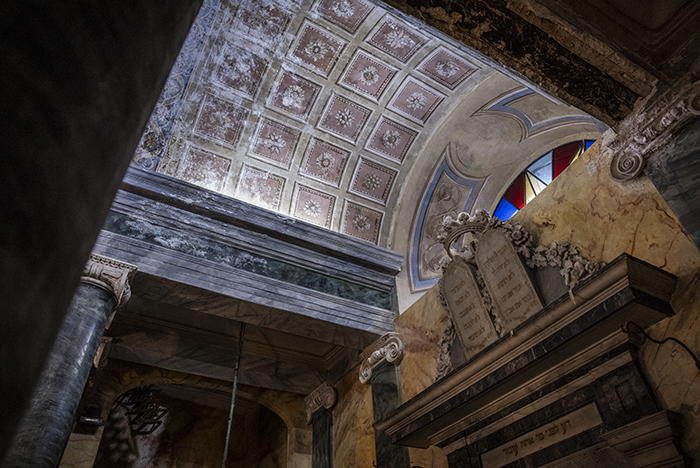
With the granting of religious freedom by King Charles Albert in 1848, Ivrea’s Jewish community, then numbering around 160 members, embarked on the construction of a synagogue by adapting an existing building along the street. The synagogue was inaugurated on 24 September 1875. Enthusiasm soon gave way to the realization that the new place of worship was larger than the community actually required, and a smaller winter prayer hall was therefore created within the same complex.
From the outside, the Synagogue blends seamlessly into the surrounding houses and workshops of the former Jewish quarter. Its modest entrance, framed by a simple stone portal, opens onto a place of worship rich in history and atmosphere. The Main Synagogue, covered by a high barrel-vaulted ceiling and articulated by neoclassical columns and pilasters, features two parallel rows of pews, faux-marble decorations and its original nineteenth-century furnishings. Among its most significant elements are the walnut-wood tevà (the platform from which the Scriptures are read and prayers are recited) and the aron (the Holy Ark housing the Torah scrolls), both positioned on the wall opposite the entrance.
Another remarkable nineteenth-century aron, carved and gilded in wood, is preserved in the Small Synagogue. One particularly moving detail is that it was deliberately darkened as a sign of mourning following the death of King Charles Albert, the monarch who had granted freedom of worship in the Kingdom of Sardinia.
While the Small Synagogue, restored during the 1980s, continues to serve Ivrea’s Jewish community, the Main Synagogue was transferred to the Municipality of Ivrea and later renovated to host conferences, exhibitions, concerts and a wide range of cultural events.