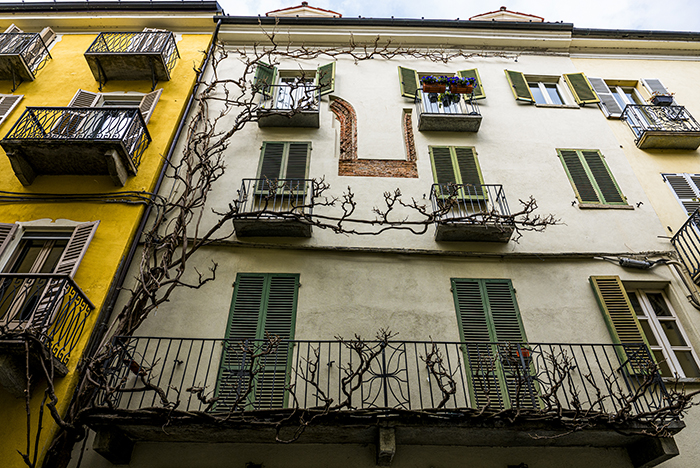
One must turn to a masterpiece — Tommaseo’s nineteenth-century Dizionario dei sinonimi e dei contrari — to find the right word to associate with Via Arduino. The word is: “ebbrezza” — that particular intoxication felt by anyone capable of picking up on atmospheres that are at once distinctive and contradictory. Tommaseo writes:
“In our day, in common usage, ebbrezza has only a figurative sense. The intoxication of pleasure, of love, the terrible intoxication of wrongdoing, of overpowering passion.”
The secret of this street lies precisely in this play of light and shadow. How could it be otherwise, given the name it carries: that of Arduino, the Margrave of Ivrea who left a mark — a controversial one — on Italian history more than a thousand years ago. For anyone who wants to discover Ivrea, Arduino certainly matters. A lapidary definition might be: he was King of Italy. Though “Italy” meant, at that time, roughly speaking, the whole of northern Italy and Tuscany; and though Romantic historiography exalted him well beyond his actual proportions, finding in him, amid the folds of the Middle Ages, what it imagined as a distant, early cry of the Risorgimento.
In any case, one must go back to the turn of the first millennium, when Arduino led the rebellion of the lay feudal lords against the growing power of the bishop-counts, who were backed at the time by the Saxon emperors Otto I, II and III. A broader conflict that reverberated here too, in the rivalry between Arduino and the Bishop Warmondo, who was determined to strengthen ecclesiastical power over Ivrea and the Canavese. Arduino was a man of action and of very few scruples. He had gone as far as Vercelli — which formed part of his March — where he burned a church and caused the death of Bishop Pietro. His grip on the other feudal lords was such that, on the death of Otto III, he was named King of Italy by the Diet of Pavia in 1002. A genuine affront to imperial authority, which makes that chapter of history an almost inextricable tangle of coronations, excommunications, expulsions, proscriptions and returns. When the Emperor Henry II descended into Italy, Arduino, though losing his crown, heroically resisted the siege at the fortress of Sparone, becoming in effect a symbol of resistance to German domination. He regained power when the emperor returned to Germany, and held it for a further ten years — though his rule was anything but peaceful and consolidated. In 1014 Henry II descended into Italy once more: defeated and ill, Arduino took monastic vows and withdrew to the abbey of Fruttuaria, where he died the following year.

But the story of Via Arduino is many other things besides the name it carries. For a start, approached from the Town Square, it climbs uphill. And not just any uphill: Via Arduino forms part of the most anomalous Decumanus Maximus among Roman cities, which were invariably built on flatter ground. But for the Romans, the opportunity to dominate the river and the mouth of the valley from a hilltop colony was too tempting to resist.
Everything is exceptional about this street. Within its first few metres one encounters: a medieval church that legend holds was born from a miracle, on the right; another church, born of the affection of the Eporediesi for a confraternity that distinguished itself during the seventeenth-century plague, on the left. A few metres further and on the right Via Quattro Martiri climbs away — part of the Cardo Maximus in Roman times, and the street where Camillo Olivetti was born. And barely two steps further, at what is today number 30, where a jeweller’s now stands, there was once the cobbler’s workshop of the Capellaro family. Why does this matter? Because the son of the Capellaros — Natalino, who left school at the age of eleven — would go on to make Olivetti great with his brilliant calculating machines, sold all over the world. In short, this crossroads with a Roman heart and a medieval charisma, which at the turn of the nineteenth and twentieth centuries represented the popular and artisan core of the city, quietly incubated the genius of men who wrote one of the finest chapters in international industrial history.
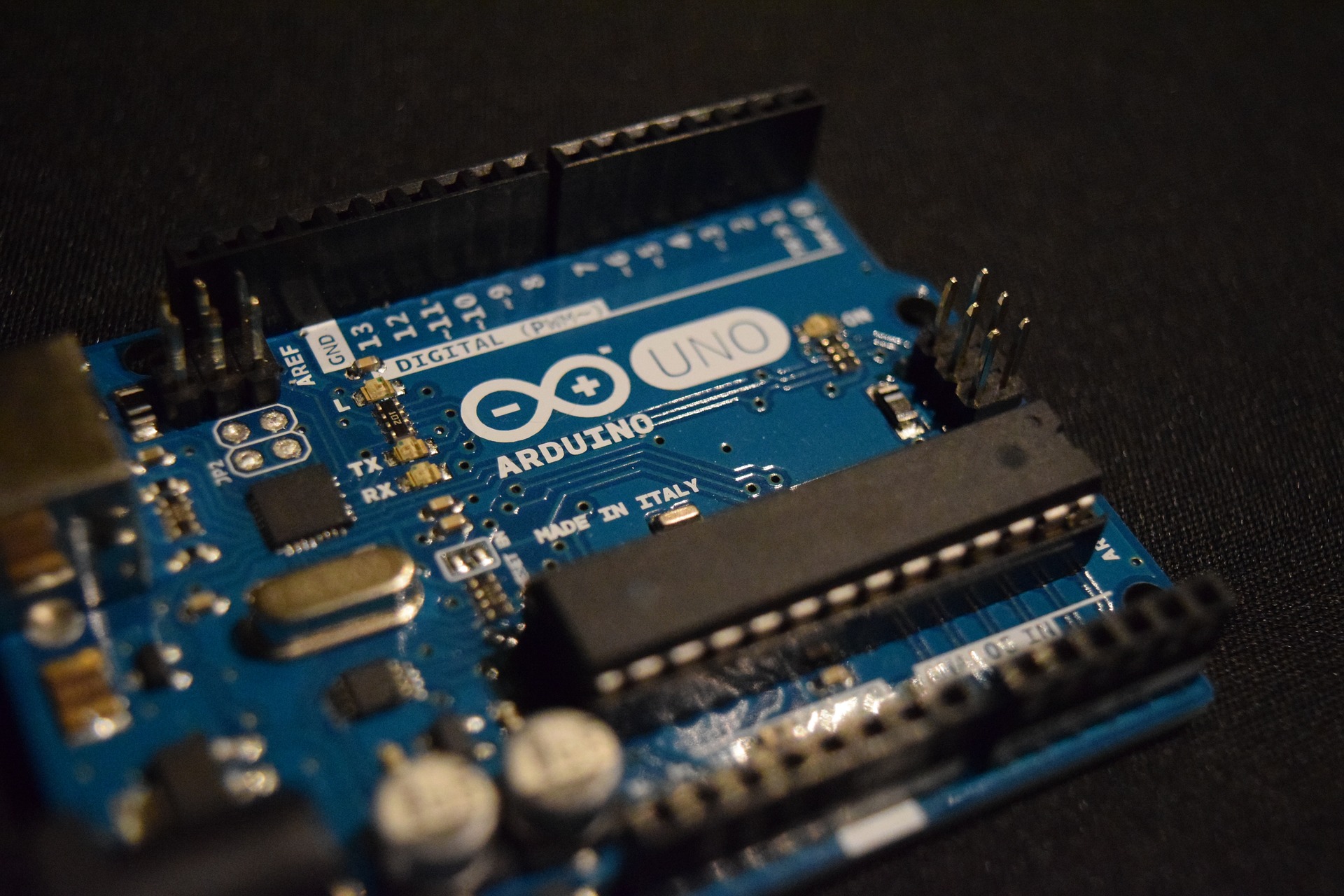
And there is more. Continuing up the street, one finds the distinctive Caffè Arduino, today home to a well-stocked antiquarian bookshop. This same bar played a small but real part in the genesis of a technological masterpiece: the celebrated open-source platform “Arduino.” Created in 2005 at the Interaction Design Institute, which was then based in Ivrea, it is today used all over the world. And Massimo Banzi, one of the five inventors, has recounted:
“Our creation is called this because when we invented it we were in Ivrea. We had five minutes before sending the circuit into production and we still had no name. At a certain point I suggested naming it after the bar where we always went for aperitivo…”
The street is nothing if not literary. And if the word “ebbrezza” suits it so well, so too does a phrase from Italo Calvino:
“The city does not tell its past, but contains it like the lines of a hand.”