

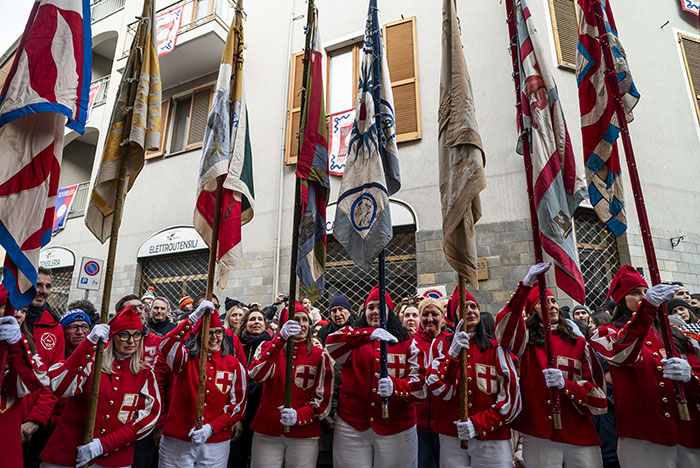
On Fat Thursday, the General is symbolically invested with full authority by the Mayor, and, in accordance with his official ordinance, citizens finally wear the Berretto frigio, the symbol of freedom and equality. For many, this marks the true beginning of the Carnival.
Then, after months of anticipation and speculation, whether true or unfounded, the identity of the Mugnaia is finally revealed on Carnival Saturday. Acclaimed by the jubilant crowd gathered beneath the Town Hall, the symbolic figure of the Historic Ivrea Carnival parades through the city’s streets, accompanied by the Historic Parade, joined by the Aranceri and Carnival revellers.
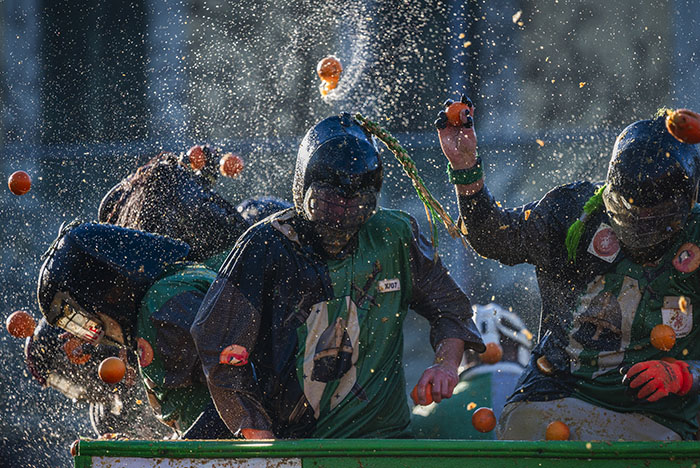
The following morning, Carnival Sunday begins with the historical reenactment of the “Preda in Dora”. In the afternoon, the city’s squares come alive with the opening day of the Battle of the Oranges and the passage of the Mugnaia. Her golden carriage is accompanied by the Historic Parade to the notes of Una volta anticamente.
On Monday morning, to the sound of the Pifferi e Tamburi, and during a ceremony conducted by the Deputy Grand Chancellor, the General and the Stato Maggiore escort newly married couples to the Zappata degli Scarli.
In the afternoon, the Aranceri and the Carri da Getto compete continuously until evening, while the Carnival’s principal figures visit each of the battle squares.
Tuesday brings the Carnival to its conclusion. The afternoon, marked by the passage of the Historic Parade and the final day of the Battle of the Oranges, culminates in the awards ceremony for the Aranceri and the Carri da Getto in Piazza del Municipio. In the evening, following the Burning of the Scarli and the symbolic funeral march of the procession, the General bids farewell to the Pifferi e Tamburi before returning to the Town Hall, where the Deputy Grand Chancellor reads the Closing Record.
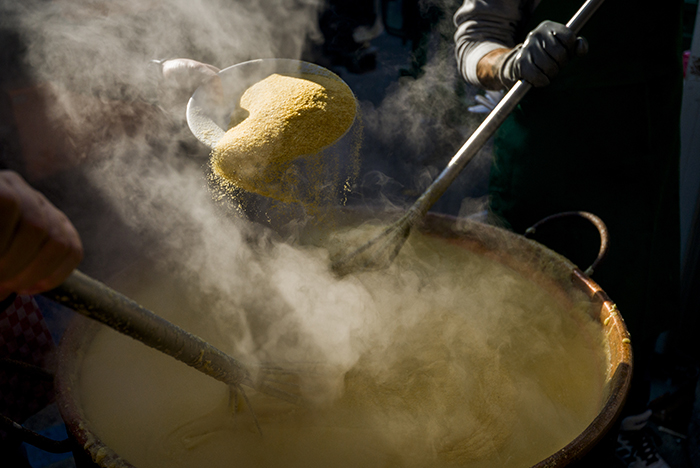
The following morning, the Carnival concludes with the traditional serving of polenta and salt cod in Piazza Lamarmora, attended by the Bishop and the Carnival’s principal figures, now dressed in civilian clothes. It is a moment that marks the end of a collective ritual which, for the people of Ivrea, is far more than a spectacle to witness: it is a shared experience, renewed year after year. The celebration comes to an end on Ash Wednesday, already looking ahead to the next Carnival.