

The building, constructed partly using materials taken from the Roman theatre, was comprehensively reworked in the Baroque style in the eighteenth century and then altered again in 1952 to take on its current appearance. On the red brick façade, traces of its long history remain visible: those of the ancient Romanesque bell tower, dating from the first half of the eleventh century; of the fourteenth-century façade, with its two windows closed by a segmental arch; and, alongside the eighteenth-century doorway, of the pointed arch that once framed the original entrance.
The façade was later enriched with the statue of Sant’Ulderico, placed high up in the triangular tympanum. It is a notable work, created by Enrico Carmassi, director of the Scuola d’Arte di Castellamonte and considered one of the most distinguished voices in Italian sculpture of the latter twentieth century. In 1973, a bas-relief in Apulian marble by the sculptor Checchi of Pietrasanta, depicting Christ, was also added.
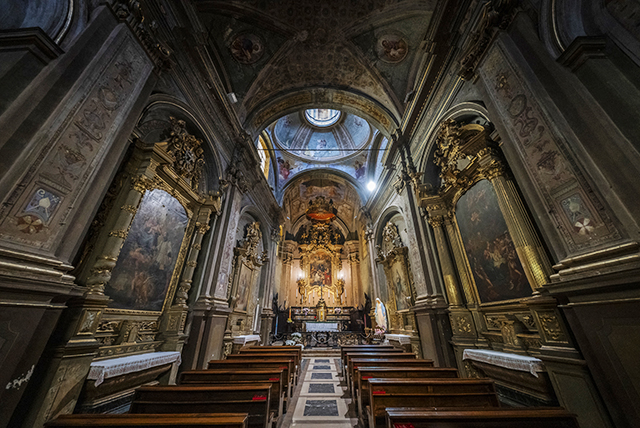
The rich interior decorations date from the late nineteenth century: the work of painters Giovanni Stornone of Ivrea and Giovanni Silvestro of Montanaro for the ornamental elements, of the Eporediese sculptor Pietro Fietta, and of Filiberto Canale for the gilding. Dating from the same period are the large frescoes depicting the Visitation of Mary to Saint Elizabeth and the young Mary being instructed by Saint Anne.
Also of note is the high altar in polychrome marble, made in 1766 by the craftsmen Marchese and Pelagatta.
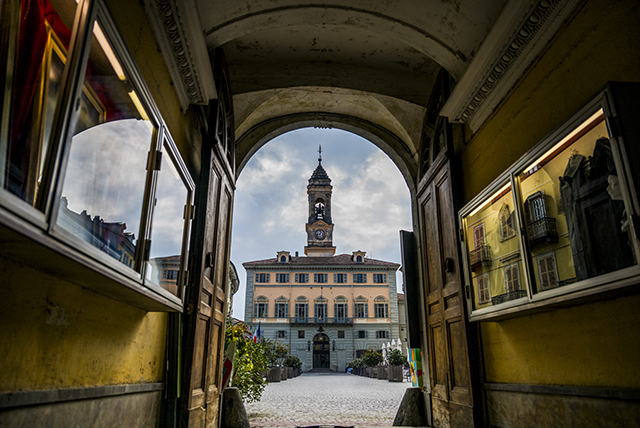
Here is a curiosity to begin with: the people of Ivrea rarely call their streets and squares by their official names. It is one of the legacies of a long history, dense with events — all significant, all concentrated within a relatively small space. So it is with Piazza Ferruccio Nazionale, which everyone simply calls “the Town Square.” The square takes on its current form in the eighteenth century. The new town hall was built between 1758 and 1761, replacing several houses and the De Burgo hospital: a rectangular building with a 27-metre bell tower topped by a wrought-iron hemp plant, the symbol of the Canavese.
The square was created at the same time and opened onto Corso Cavour between 1826 and 1828, when the corso itself was laid out. The heart of the historic centre, of its daily life and of the celebrations of the Historic Carnival of Ivrea, it still divides Via Palestro — the ancient Decumanus Maximus — from Via Arduino, its continuation.
Named after Vittorio Emanuele I in 1759, it took the name of Ferruccio Nazionale at the end of the Second World War, in honour of the partisan hanged here by the Fascists on 29 July 1944. A young Olivetti worker born in 1922, he joined the resistance under the name “Carmela,” first with the 2nd Caralli Brigade and then with the 76th Garibaldi Brigade. He attempted, unsuccessfully, to assassinate the military chaplain affiliated with the X MAS. Captured, he was tortured, hanged in the square and left there for many hours as a warning to all. Around his neck was a sign: “He had attempted with arms to strike the Decima.” Ferruccio Nazionale is therefore one of the symbols of the Resistance in the Canavese.
Finally, the Church of Sant’Ulderico faces onto the square — completing, with its devotional dimension, the vast and varied fabric of histories, cultures and sensibilities that are represented and preserved here.