Camillo Olivetti

From Ivrea to America

Listen to the audio story

If we were to describe Camillo Olivetti’s gaze with just one adjective — a gaze preserved in the few precious close-up photographs that portray him — we could justifiably call it “piercing.” His light-colored eyes convey not only determination, but something more: the ability to focus on a goal and keep it firmly in sight. It could hardly be otherwise for a man who, throughout his life, managed to balance aspirations that might seem at odds with one another: on the one hand, building and growing a profitable business; on the other, giving tangible form to unmistakably socialist ideals.

Samuel David Camillo was born in Ivrea on August 13, 1868, into a family of Jewish heritage and had the opportunity to pursue an education that was far from common at the time. In 1891, he graduated in Electrical Engineering from Turin’s Royal Industrial Museum, the institution that would later become the Polytechnic University of Turin. He then moved to London, where he perfected his English and joined the Socialist Party. In 1893, he accompanied Galileo Ferraris to the International Electrotechnical Congress in Chicago. While in the United States, he also served as an assistant at Stanford University.

A brilliant engineer and designer, he returned to Ivrea and, in 1896, founded a company manufacturing electrical measuring instruments in a small red-brick factory of his own design. At the same time, he remained true to his socialist ideals and, as a report held in his name at the Ivrea Police Headquarters states, “left no opportunity unused to instill his ideas among the working class.”


The ethics of profit
The masterpiece

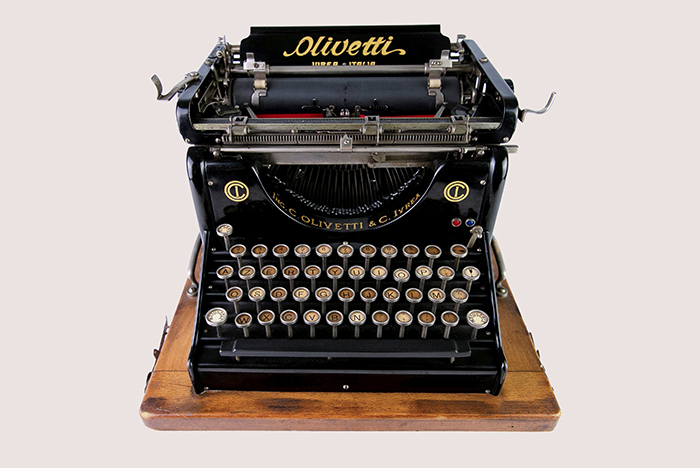
In 1903, he relocated the business — later renamed C.G.S. (Centimetre, Gram, Second) — to Milan. Meanwhile, in Ivrea, in the very same building, he established in 1908 the Ing. C. Olivetti & C., the First National Typewriter Factory. It was his masterpiece. Building on the success of the M1, unveiled at the 1911 Turin International Exposition, the company expanded rapidly and, nine years later, entered international markets with the M20.

Camillo personally selected and trained his first workers. He was an authoritative yet generous leader, a combination that led him to provide his employees with pioneering social welfare services.

From 1899, he was married to Luisa Revel, a Waldensian, with whom he had six children: Elena, Adriano, Massimo, Silvia, Laura, and Dino. The second of them, Adriano, worked alongside him in the company. Together, they reorganized the production line and expanded the commercial network until Adriano became President in 1938.

Dramatic times, however, were approaching. After September 8, 1943, with the arrival of the Nazis, Camillo, by then seriously ill, was forced to leave Ivrea. He took refuge in the Biella area, where he died on December 4, 1943.

At his funeral, a vast crowd of women and men from across the Canavese region accompanied him through the rain to his final resting place, the Jewish cemetery of Biella.