

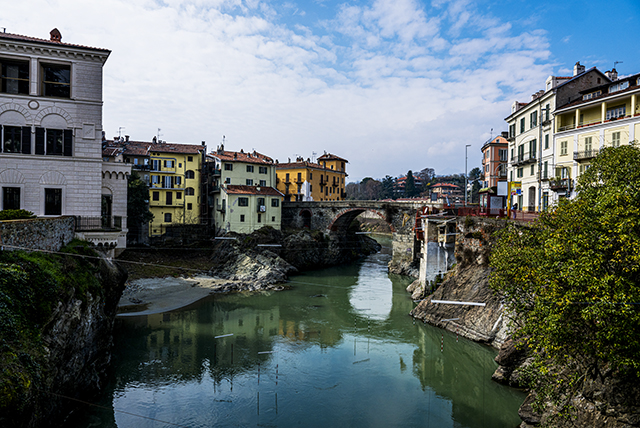
Perched on the right bank of the Dora, the Borghetto was, and still is, introduced by the Ponte Vecchio — known in earlier times also as the Ponte Canavese. The Ponte Vecchio is one of the city’s symbols and has a troubled history: built in the Roman era — though few traces of its origins remain, at the base of the main piers — it was for centuries the only route of access to southern and western Canavese. Severely damaged by the river’s floods, it was rebuilt in wood and remained so until around 1600. Rebuilt in stone, it lasted only until 1704, when it was blown up during the French siege. In 1716 it was reconstructed with a roof and two guard towers. It then took on its current appearance in 1830, when it was widened to accommodate the increase in horse and carriage traffic.
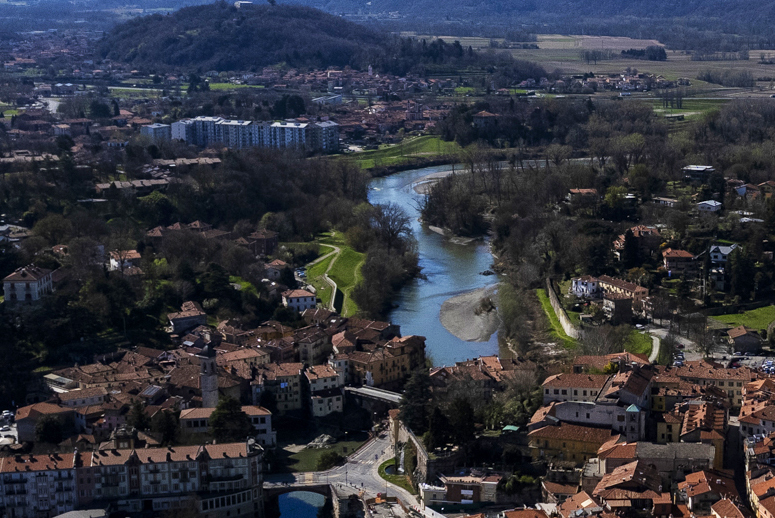
A curiosity: just upstream from the Ponte Vecchio, for at least five centuries the riverbed was home to floating mills, resting on boats tied to the bank by thick ropes that held them in place. These mills were owned by the wealthiest families of Ivrea, who rented them to millers — who were apparently permitted to keep for themselves just one sixteenth of the flour they ground, and were also required to repeat a public oath of honesty every year. What did these unusual mills look like? Two parallel hulls, on top of which rested a kind of hut spacious enough to contain the millstone, a small storeroom and a shelter for the miller. The force of the current turned the paddles, which in turn drove the millstones. The mills were positioned so as not to obstruct the passage of timber floated down from the Aosta Valley: at the time, the transport of lumber was done by river. First mentioned in a document from the early fourteenth century, they had been present for considerably longer and survived at least until the mid-nineteenth century.
These are not trivial details: the importance of millers in the daily medieval life of Ivrea is attested by certain laws. For example, after dark it was strictly forbidden for anyone in the city to move around without carrying a lantern — with the exception of officials, watchmen, doctors, bakers, and millers. The very heroine of the Historic Carnival of Ivrea is, not coincidentally, the Mugnaia — the miller’s daughter.
At the heart of the Borghetto stands the church dedicated to San Grato, the second Bishop of Aosta. The only religious building in Ivrea with a Latin cross plan and a central dome, it has a fine neoclassical façade and contains notable paintings, recently restored and returned to the community thanks to the generosity of its parishioners.
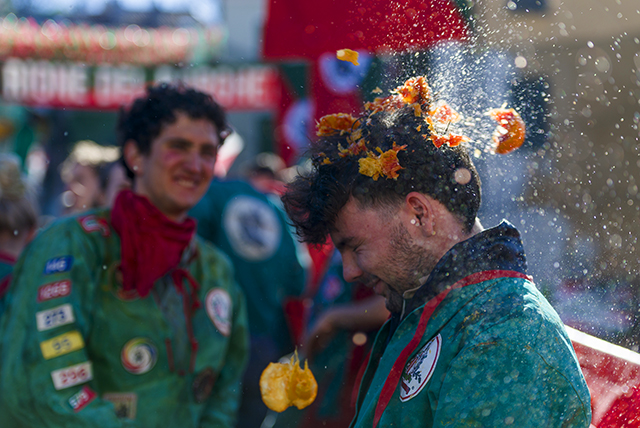
Finally, the ancient and proud autonomy of the Borghetto lives on, year after year, in the Battle of the Oranges at Carnival: it is the only battle square on the right bank of the river, and the only one in which a single team competes — the Tuchini.