

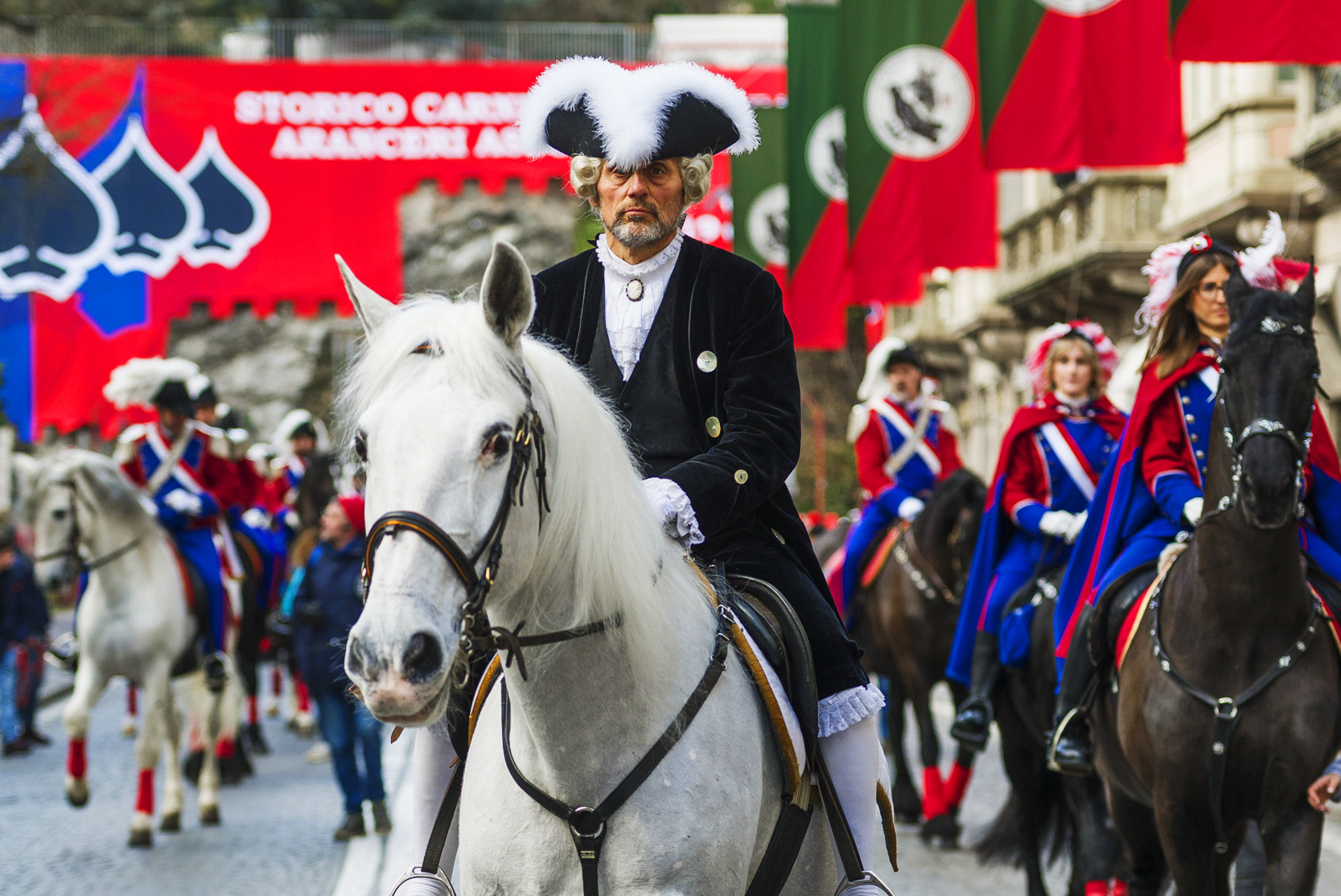
In the nineteenth century the Carnival shed its purely neighbourhood character and gained the figures that would go on to form its future historical procession.
On 1 March 1808 the first General was appointed: Antonio Pezzati. The appointment was recorded in the first Book of Records and, shortly after, in 1820, the first General Staff was formed.
In 1845 one of the Carnival’s defining figures made his appearance: the Sostituto del Gran Cancelliere.
Finally, in 1858, the first Mugnaia appeared: Giuseppina Fumel Gamacchio. The Mugnaia is a symbol of freedom and is celebrated through the birth of the Canzone del Carnevale — music and words that, from that moment on, would tell her story forever: that of a miller’s daughter named Violetta, who kills the tyrant and ignites the popular revolt.
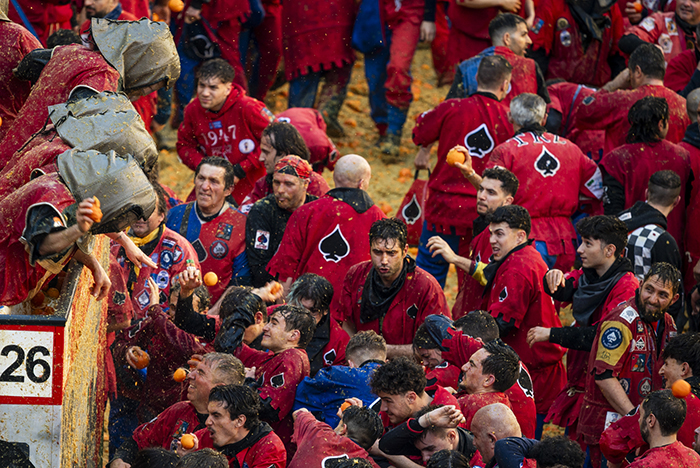
Between 1924 and 1934, the procession was completed with the birth of the AUC goliards, and the introduction of both the figure of the Podestà and the re-enactment of the “Preda in Dora” on the Ponte Vecchio.
It was in the post-war period, however, that the Carnival changed radically, with the arrival of the Battle of the Oranges in the city’s squares. In 1947 the Battle began to take the form it has today: it re-enacts the clashes between the people — the Aranceri on foot — and the tyrant’s soldiers — the horse-drawn Carri da Getto. The first team, the Asso di Picche, was founded that same year. The other eight teams grew from subsequent gatherings of small groups of friends: the Morte in 1954; the Tuchini del Borghetto, the Scacchi, the Pantera Nera and the Scorpioni d’Arduino between 1964 and 1966; the Diavoli and the Mercenari in 1973 and 1974; and finally the Credendari in 1985.
Around the turn of the century came further developments that, in practice, gave us the Carnival as we know it today. In 1991 the Scorta d’Onore was established. In 1996 the Alfieri joined the historical procession, replacing the old parish standard-bearers. In 2022 the group Armigeri di Yporegia, known as the Scorta del Podestà, was founded.
The Aranceri a piedi and the Carri da Getto formally established their respective associations in 2000 and 2002. It is precisely with the birth of these associations, which bring together thousands upon thousands of people, that the Carnival confirms itself as an expression of the Eporediese spirit of self-determination.
Nine centuries after the legend of the tyrant slain by Violetta, the Historic Carnival of Ivrea continues to embody the values of Freedom, to pass on its symbolic meaning, and to affirm itself as a civic celebration for all.