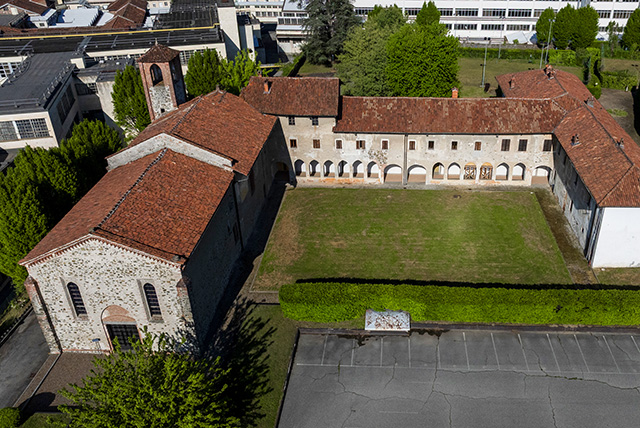
Between 1455 and 1457, on the hill of Monte Navale, the Church of San Bernardino and the convent for the Franciscan order of the Friars Minor Observant were built, in devotion to the figure of San Bernardino da Siena, who passed through Ivrea in 1418.
What makes the church of exceptional importance is the fresco it houses, the work of the Casale-born artist Giovanni Martino Spanzotti: the pictorial cycle Vita e Passione di Cristo, painted on the church’s partition wall between 1485 and 1490, and considered one of the most significant Renaissance works in Piedmont. The life of Christ is told in 20 scenes, all organised around the large central panel of the Crucifixion.
Why is the work so important? Giovanni Testori explains it better than anyone, in his essay Giovanni Martino Spanzotti. Gli affreschi di Ivrea, published by the Centro Culturale Olivetti in 1958. For Testori, humanity is the work’s defining quality — the element of discontinuity with earlier art. Populating every scene are the faces and figures of ordinary people: a vision closely aligned with the demands of Franciscan ethics.
Being the great writer he was, Testori reaches for literary images: the painter wrestling with his immense task, observing everything feverishly before putting brush to wall, going out to see how night falls in the woods, running his hands over animals as if to learn their forms. And finally, seeking inspiration in the faces and bodies of people encountered in the street:
“Look at the Crucifixion, the ultimate concession that the valley-born Martino could make to the aesthetics of the Renaissance. They are travel memories, nothing more, because his was a poetry of Piedmontese reticence, a poetry of the people: the limbs of peasants, legs that have followed donkeys up mule tracks, arms that have dug the earth, backs bent under baskets and stones. But in Ivrea, old Martino’s father had eyes above all for Martino’s miracle: that violet air, that snowy air, that air which even in the night scenes knows how to warm itself in the tenderness of every thing, however humble, however modest…”