

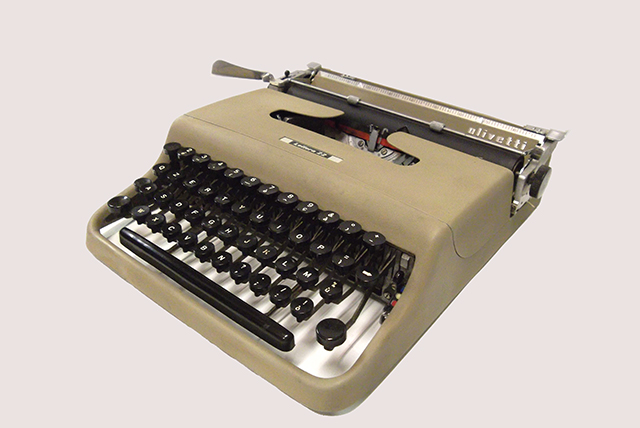
Just open any issue of the monthly company magazine Notizie Olivetti at random to be struck by its richness. Take, for example, issue no. 41 from October 1956. One correspondent describes the curiosity of passers-by outside the new Olivetti store on Fifth Avenue, where the Lettera 22 is displayed outside the shop more like a work of art than a commercial product. Then there is the report from the Venice International Film Festival, where Olivetti supplied 150 typewriters, with Alberto Sordi photographed as he discovers the Lettera 22; an account of a cultural journey to Sardinia by three young employees; a lengthy essay by Orio Vergani dedicated to Giuseppe Giacosa; reviews of La bufera e altro by Eugenio Montale and Fuochi fatui by Camillo Sbarbaro; the biography The Life of Sir Arthur Conan Doyle by John Dickson Carr; the report of new acquisitions for the Central Library; the Autumn Festival in the Canton Vesco district, featuring sporting competitions, dances, and chestnut roasts; the competition for architects to design the Olivetti mountain holiday camp; a photography competition devoted to readers’ holidays; the university scholarships awarded by the company; a photograph of some of the 300 children hosted at the Monteluco di Spoleto holiday camp; and the trip to Cologne for the International Exhibition organised by the photography section of the Olivetti Sports and Recreation Club.
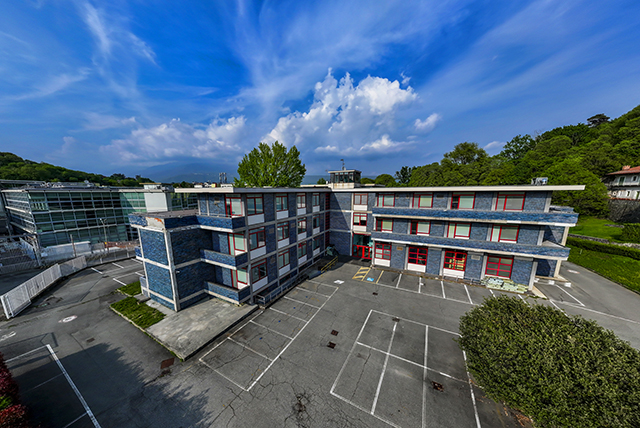
Now let us turn at last to the Centro Studi ed Esperienze, affectionately known to many people in Ivrea as the “Blue House”. Someone once explained that “classic” is “that which transcends the contemporary” and that, precisely for this reason, it speaks a universal language that never goes out of date. This is also true in architecture, as in the case of this building, which has stood the test of time. Art historian Riccardo Musatti described the Study and Research Centre as “a masterpiece of architectural literature”, created in the early 1950s under the direct supervision of Adriano Olivetti. In a company focussed on innovation and research, there was an ever-growing need to concentrate product research and design activities in a single, physically separated space, where work follows rhythms and criteria different from those of the rest of the factory. For this project, which was so far removed from the tradition of industrial plants, Olivetti chose a young architect open to new ideas: the 28-year-old Neapolitan Eduardo Vittoria. The project was launched in 1951 and was then completed between 1954 and 1955.
The building has a cruciform layout, with a central block housing general services, a large rhomboidal stairwell and a magnificent glass skylight. Four wings branch out from this central core, each differing in shape and size. Each wing is dedicated to the development of one of Olivetti’s four core product categories: typewriters, calculators, accounting machines and teleprinters.
It is immediately apparent that the Study and Research Centre marks a new phase in Olivetti’s architectural style. References to masters such as Frank Lloyd Wright and Ludwig Mies van der Rohe are also incorporated into the field of industrial architecture.
Alongside the terraces, large windows and balconies, the heart of Eduardo Vittoria’s design is colour: tiles ranging from dark blue to light blue are used for large, vibrant spaces, thus creating an effect of openness and brightness that it is no exaggeration to describe as “Mediterranean”. This distinctive style was fully respected in the extension designed by Ottavio Cascio from 1965 onwards, to the extent that it is almost impossible to distinguish the original structure from the subsequent additions.