

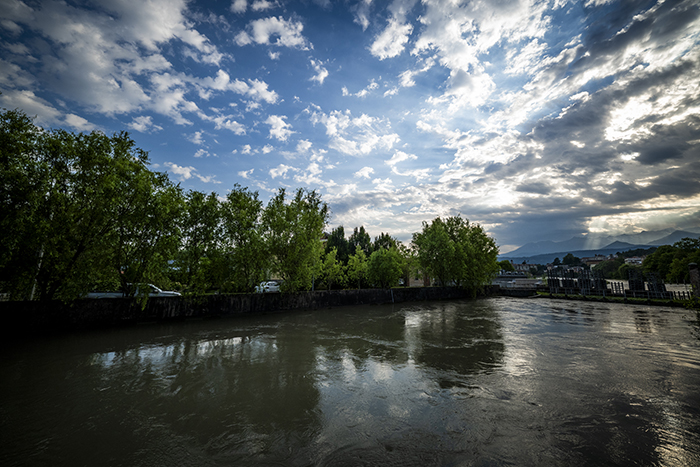
The canal rises from the Dora Baltea near the historic centre of Ivrea, where the river leaves the urban fabric and heads out toward the plain. From here the Naviglio continues south-east, following the edge of the Moraine amphitheater of Ivrea, skirting the hills of Masino and running alongside the Dora Baltea for a stretch through the narrows at Mazzè. It then continues toward Villareggia, enters the Vercelli plain and passes through places such as Cigliano, Santhià, San Germano Vercellese, before reaching Vercelli, where its journey ends as it flows into the Sesia.
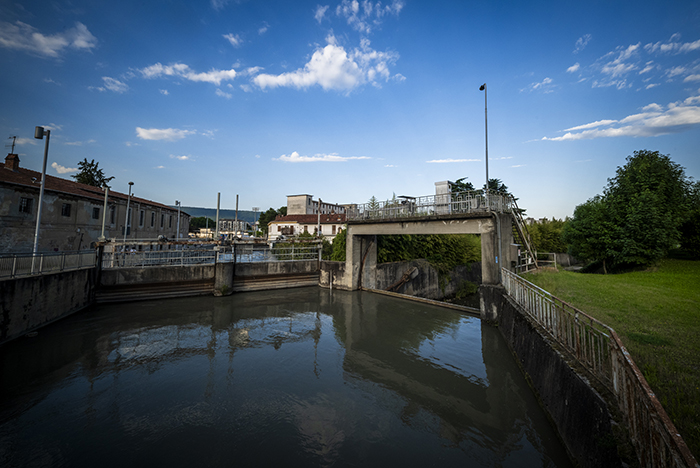
Over the centuries the Naviglio was the subject of numerous interventions aimed at improving its efficiency.
Leonardo da Vinci, who took a keen interest in the hydraulic systems of northern Italy, studied its workings and proposed several innovative solutions, though none of them were ever carried out.
Later, in the early nineteenth century, under French rule, the ancient fortifications of Ivrea that had long protected the eastern side of the city were gradually demolished to allow the town to expand beyond its walls. As part of this process, a tree-lined promenade was created along the first stretch of the Naviglio, at the level of what is now Piazza del Rondolino. On 5 August 1811, on the Emperor Napoleon Bonaparte’s birthday, it was named the “Boulevard de la Doire.” For the occasion, part of the old bastion was demolished, opening up a broad passage that allowed residents to descend easily toward the countryside and the Naviglio. Shortly afterwards, the Journal de la Doire reported how the people had “felt great satisfaction at being able to descend for the first time through this promenade into the countryside.”