

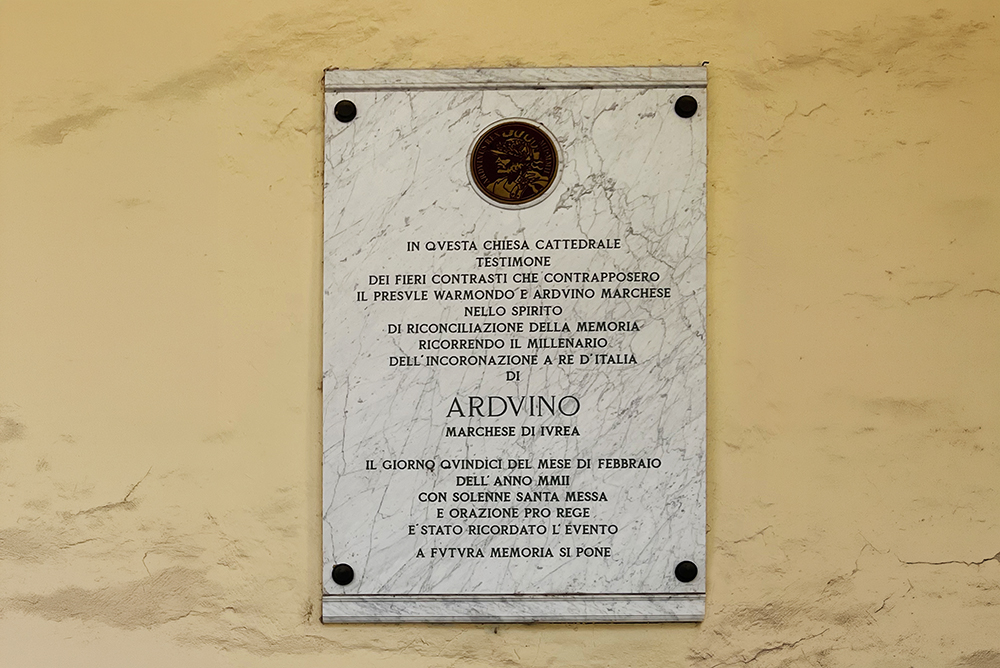
The core of the present church (built extensively using materials reused from Roman buildings) was constructed between 970 and 1005 at the initiative of one of the most influential figures in Ivrea’s history: Warmond, Bishop of Ivrea from approximately 965–968 until 1011.
A member of the noble Arborio family, Warmond greatly enriched the city’s religious life, not least through the cathedral’s scriptorium, where scribes, illustrators and illuminators produced magnificent manuscripts. Among the finest surviving examples, now preserved in the Chapter Library, is the Sacramentarium Episcopi Warmundi, completed in 1002.
Warmond is remembered above all for his fierce conflict with Arduino, Margrave of Ivrea. The two clashed over feudal rights in the territory surrounding the city. Supported by Emperor Otto II, Warmond was granted the authority to administer justice, collect taxes and raise troops, effectively becoming a prince-bishop loyal to the Empire. Arduino, however, backed by several of his vassals, drove Warmond from Ivrea by force, an act that resulted in two severe excommunications.
Elected King of Italy in 1002, Arduino was defeated two years later by the new Emperor Henry II, although he continued to resist until 1014. Warmond was then able to return to his diocese. His remains are preserved in an urn within the Cathedral, and in 1857 Pope Pius IX declared him Blessed.
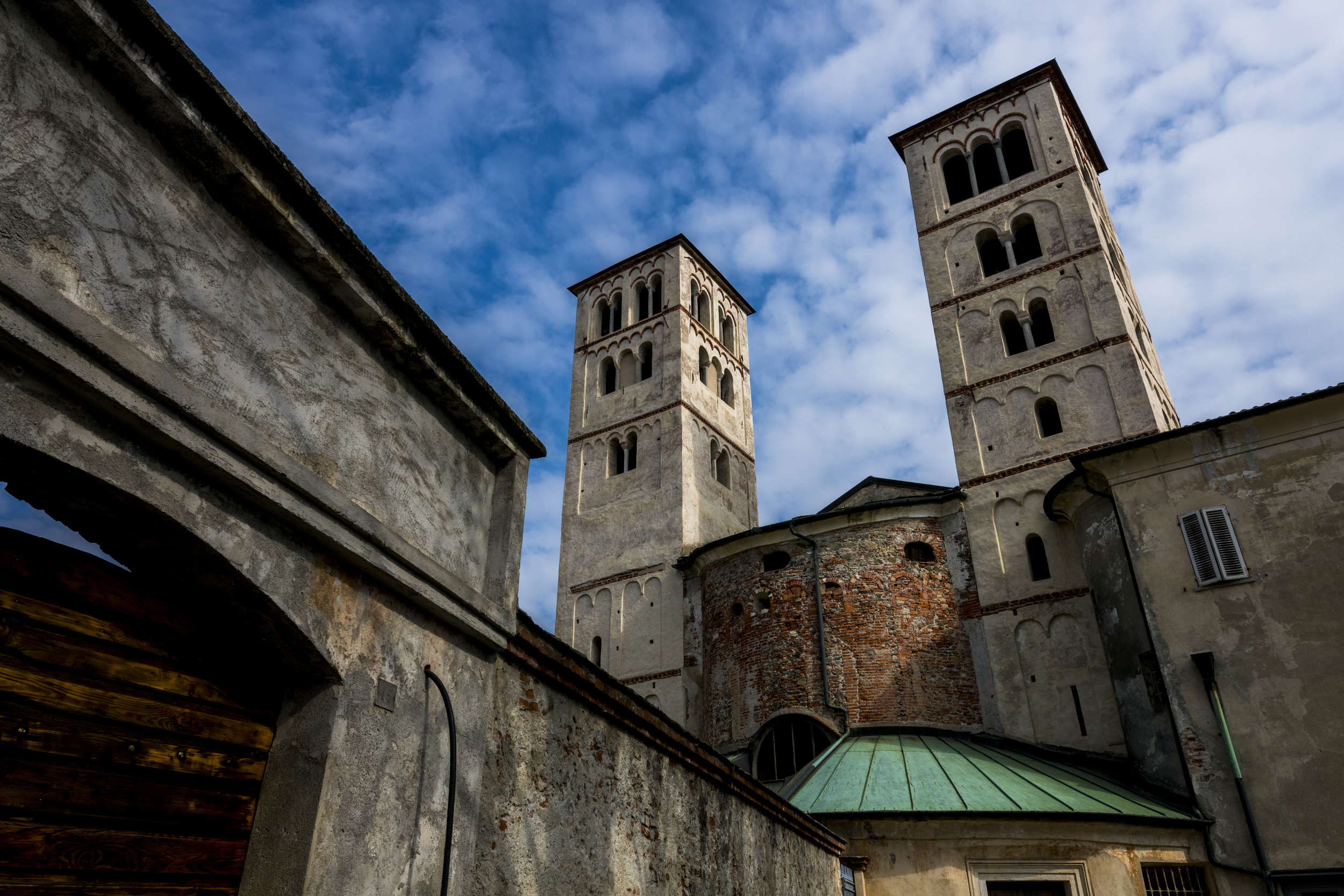
The Cathedral owes its Romanesque reconstruction to Warmond. The imposing octagonal lantern tower and the two magnificent bell towers, adorned with single-, double- and triple-light windows, date from the eleventh and twelfth centuries. Beyond the apse lies the canonical cloister, or “Canon’s Garden”, still clearly visible today, although incorporated into the surrounding walls. From here, the clergy once accessed their living quarters, study and writing rooms, refectories, workshops and guesthouse: all buildings demolished during the fourteenth century to make way for the construction of the Castle.
The Cathedral, with its longitudinal plan and three-aisled layout, still preserves several important features from its Romanesque phase: the crypt, the apse, the upper ambulatory, the bell towers and the octagonal lantern tower (tiburio).
Dating from 1464 is the sacristy, which houses two important works by the Piedmontese painter Defendente Ferrari: the Adoration of the Christ Child with Saint Clare and the Poor Clares, originally from the former Convent of Santa Chiara in Ivrea, and the Adoration of the Christ Child with Blessed Warmond, painted in 1521.
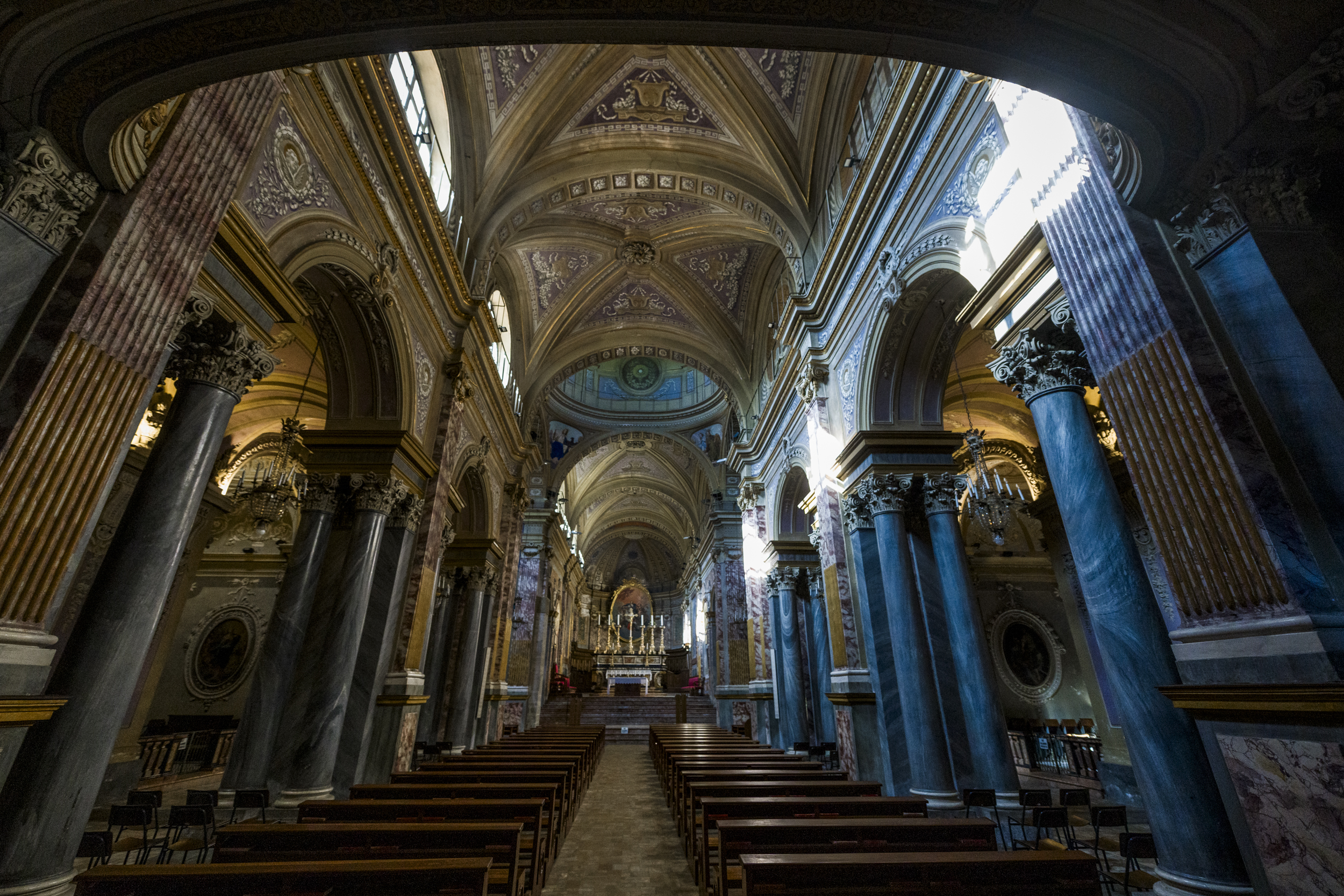
During the second half of the eighteenth century, the Cathedral was enlarged through the addition of side chapels, including the Chapel of Saint Savino (now dedicated to the Blessed Sacrament and the Chapel of Saints Peter and Paul, also known as the Chapel of the Crucifix). Although its Romanesque structure remained intact, the church gradually acquired a distinctly Baroque appearance.
The final major architectural transformation was promoted by Bishop Luigi Moreno. In 1853, works began, to designs by architect Gaetano Bertolotti, to extend the Cathedral and construct a new façade. Inspired by Palladio’s façade of San Giorgio Maggiore in Venice and decorated with sculptures by Giuseppe Argenti of Novara, the new Neoclassical front gave the building its present appearance. Additional side chapels and a small baptistery were also built.
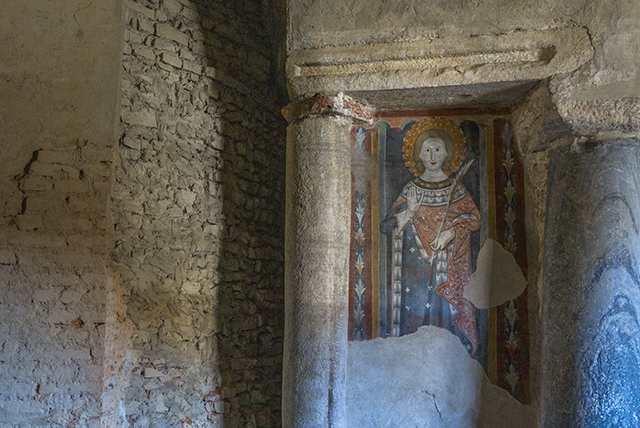
The Cathedral’s crypt is one of its most remarkable features. Its oldest section dates back to the eleventh century and was constructed after Arduino brought the relics of Saint Besso to Ivrea. The space was enlarged during the twelfth century. The earlier section is characterised by groin vaults supported by slender columns with truncated-conical capitals. In the later section, built during the twelfth and thirteenth centuries and dedicated to Saint Gaudentius of Ivrea, visitors can admire capitals decorated with plant and animal motifs, together with important frescoes depicting Saint Gaudentius, the Annunciation and the Virgin and Child, attributed to Giacomino da Ivrea, a fifteenth-century painter active in the Canavese region.
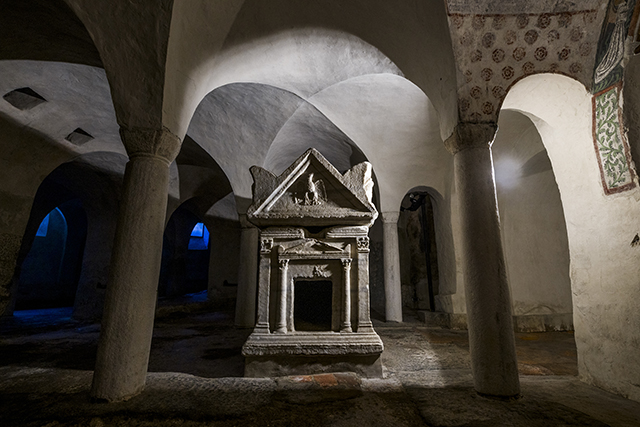
The crypt also preserves one of Ivrea’s most important Roman artefacts: the sarcophagus of the quaestor Gaius Atecius Valerius. A prominent citizen of ancient Eporedia, Gaius Atecius Valerius received the exceptional privilege of being buried within the city walls, a distinction normally forbidden under Roman law, granted to him after his death at the request of his children. His finely carved quartzite sarcophagus remained undisturbed until 997, when Arduino brought the relics of the martyr Saint Besso from Ozegna to Ivrea. Before placing the saint’s remains inside it, Arduino ordered the sarcophagus to be ritually purified. It was then installed in the Cathedral crypt as a reliquary. To allow the faithful to view the relics, an opening was cut into the centre of its original Latin inscription, a feature that remains clearly visible today.
The relics of Saint Besso are still preserved within the Cathedral. Since 1796, however, they have been kept in a shrine within the altar of the Chapel of the Blessed Sacrament.